Showing posts with label dog. Show all posts

Wednesday, November 4, 2009

WINTER POOL SAFETY FOR YOUR PET


Colder weather means less people in their back yards.
Most people are not using their pools and some even close down their pools and don't look at them until Summer.

This could be one of the most important times to have a Skamper-Ramp in the pool.


Potentially an animal could fall in the pool and no one will find it until warmer days.
This can lead to contamination and/or loss of a pet.

Skamper-Ramp is an all year round safety product!
Keep your pet safe all year round!

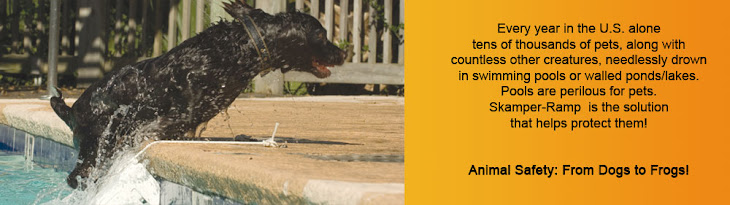
Each year, in the U.S. alone, over 50,000 family pets drowned needlessly in swimming pools and walled lakes, along with countless millions of other animals.

Skamper-Ramp is a simple, inexpensive solution to prevent these deaths. Whether it’s a frog, squirrel or a pet, you will have no more morning surprises with Skamper-Ramp on duty. It is the animal rescue device that will help protect pets and wild animals from accidental drowning whether or not you are in the area.

If you have flotation vests or safety turtle alarms or any of several other safety products at your pool, Skamper-Ramp is a natural partner to own.

The life saving Skamper-Ramp is the only water rescue device on the market that protects animals from drowning—even if no one is home!! The large Skamper-Ramp when used with boats and docks will help them actually get out of the water without the aid of their owner, not just keep them afloat.

This simple white, corrugated, recyclable, polypropylene plastic ramp attaches to the side of the pool, walled pond/lake, most docks, and even many boats.

The science is that ALL living beings - domestic or wild; bugs, animals or humans; whether they are colorblind or not - see 550nm wavelength, which is the color white. As long as the Skamper-Ramp is installed so that a few inches of the "nose" (curved) end are under water and the ramp breaks the surface, the animal will see it, day or night, and they will safely “skamper” out on the ramp.

For more information about Skamper Ramp visit www.blueridgepetcenter.com


.

Saturday, October 10, 2009

Training Your Dog to Listen to You

Training Your Dog to Listen to You

Why Won't My Dog Listen To Me?

This is a common question that most first-time Dog owners ask me. Before I answer your question, let me ask you a few instead:

  • Do you use cookies, collars, head halters or clickers to make your Dog listen to your commands?
  • Do you have to raise your voice every time you want your Dog to listen to you?
  • Does your Dog always come or sit on command - anytime and anywhere you want him to?

If your answers are mostly in the negative, its time you seriously reconsider your role as a sincere Dog trainer and an ideal pet parent.


The Wicker/Rattan Pet Home shown above is available in four sizes through www.blueridgepetcenter.com


Get Your Dog To Listen To You

Before you begin any training, you must first establish yourself as the "ALPHA dog" of your family. Your Dog must know that you’re the leader of the pack and it is YOU who is in charge.

Here is a list of simple DO's and DONT's that you must follow if you want to be the Alpha:

  • Always go out or come in through the door first - remember you are the leader;
  • Always eat first - give your Dog something to eat only after you've finished your meal;
  • Don’t circle around your Dog when he is lying on the floor - make your Dog move out of your way instead;
  • Don't let your Dog set the rules - pay attention to him when you think fit and not whenever he demands;
  • Don’t permit your Dog to sleep with you in your bed - demarcate his sleeping area clearly.

Once you successfully established yourself as the Alpha, training your Dog and making him listen will be a lot easier than you can imagine. Remember, if your Dog does not learn to "listen", all your training efforts will be in vain!

Does your Dog know his name? Does your Dog look at you whenever you call him by his name? This is the first and the most critical step involved in Dog Training. If your Dog doesn't respond to his name, you cannot have his attention for teaching him any other commands.

To make sure that your Dog recognizes his name, take a treat in your hand and hold it away from your body. Call your Dog's name. He is most likely to look at the treat in your hand. Continue calling his name untill he turns and looks at your eyes. Give him the treat immediately. Repeat this exercise by holding the treat in the other hand. Once you're sure that your Dog has learnt to recognize his name, just call his name and reward him for looking at you by petting or with a hug.

You must understand that Dogs respond far better to positive reinforcement than they do to coercion or force.

Learn how to train your Dog better with this free mini course.

Copyright (c) 2009 TrainPetDog.com


Want To Own A
Well-Trained, Obedient, Healthy, Fully Housebroken,
Disciplined & Happy Pet Dog?

Introducing Hands-off Dog Training Secrets and Information With Fast, Effective Results That Save Hours Of Your Time Every Week!!

Sign up for a FREE mini course on training your Dog


You can heal your pets at home safely and easily, and save money at Vet the today...
You're About To Learn Secrets That Most People Will Never Know About Healing Their Pets


Wednesday, October 7, 2009

BASICS OF DOG TRAINING


Basics of Dog Training

It's essential for Dog parents like you to know certain basic factors that determine your relationship with your Dog and can go a long way in training him effectively.

Before you begin training your Dog, it is absolutely essential that you build a loving bond with him. This is important as it helps you to understand his needs and instincts and also allows your Dog to have complete trust in you.

Know more about Dog care from this free mini course

Let us see how.......

How To Bond With Your Dog

Building a bond with your Dog is the first and the most crucial step involved in training him successfully. As soon as you bring your Dog home, you must first try to develop a caring and loving relationship with him in order to win his trust and confidence.

When Dogs are secure in the knowledge that they belong to the family, they are more likely to respond better to their owners' training commands. Just like with any relationship, there must be mutual trust and respect between you and your Dog.

Trust takes time to develop and respect comes from defining boundaries and treating any breach of those boundaries with firmness and fairness.

Without enforceable limitations, respect can’t be developed. And when there is no respect, building a bond with your Dog is almost impossible.

4 Golden Rules To Building A Relationship With Your Dog :

  • Spend quality time together;
  • Take him out in the world and experience life together;
  • Establish and promote a level of mutual respect; and
  • Develop a way of communicating to understand each other's needs.

Building a bond with your Dog will not only help you manage him better but will also make your Dog calm, quiet and an extremely well-adjusted pet.

Love Your Dog and He Will Love You back

Once you're succesful in building a bond with your Dog, you can rest assured that training him and teaching him new and clever tricks will be a cakewalk.

Learn how to bond with your Dog with this free mini course.

How Your Dog Learns...

Your Dog's learning period can be divided into five phases:

The Teaching Phase - This is the phase where you must physically demonstrate to your Dog exactly what you want him to do.

The Practicing Phase - Practice makes Perfect. Once a lesson is learnt, practice with your Dog what you have just taught him.

The Generalizing Phase - Here you must continue practicing with your Dog in different locations and in an environment with a few distractions. You can take your Dog out for a walk, or to a nearby park and command him to practice whatever you've taught him.

Practicing the learned lessons in multiple locations and in the presence of small distractions will help him learn and retain lessons better .

The Testing Phase - Once you're sure that your Dog has achieved almost 90% success....he responds correctly almost every time you give a command, you must start testing his accuracy in newer locations with a lot of distractions.

Example: Take him to the local shopping mall and ask him to obey your command. He may not come up with the correct response the very first time you do this, but you must not lose hope.

The idea is to test your Dog to see how he responds in an environment which is new to him. Set-up a situation where you are in control of the environment and your Dog.

There are only 2 possibilities:

  • Your Dog succeeds!!! (Trumpets please!)
  • In case your Dog fails, re-examine the situation. Review and/or change your training. Then try testing again.

Keep on testing until he succeeds. Follow the rule of the 3 Ps – patience, persistence, praise.

Internalizing Phase - Finally, comes the extremely rewarding phase where your Dog does everything he is taught to do even without your commands.

Remember:

  • Never scold your Dog if he fails. It's not his fault. You have failed as a trainer!
  • You must be patient and persistent for your efforts to show rewards.
  • Appreciate and love your Dog when he does it right! A little encouragement will work wonders for your Dog.

Learn how to train your Dog better with this free mini course.

Copyright (c) 2009 TrainPetDog.com


The dog bed shown above is available through www.blueridgepetcenter.com


Want To Own A
Well-Trained, Obedient, Healthy, Fully Housebroken,
Disciplined & Happy Pet Dog?

Introducing Hands-off Dog Training Secrets and Information With Fast, Effective Results That Save Hours Of Your Time Every Week!!

Sign up for a FREE mini course on training your Dog

Saturday, October 3, 2009

YOUR PET COULD BE A TAX WRITE-OFF


Your Pet Could Be a Tax Write-Off


Imagine if your pet care expenses were tax deductible. I would wager that most pet owners have thought about it before - I do every year. After all, we can deduct our own health care expenses and many of our purchases, so why not our pets?


Soon, tax-deductible pets could become a reality if a proposed bill passes.


Enter H.R. 3501: the Humanity and Pets Partnered Through the Years (HAPPY) Act, introduced by U.S. Representative Thaddeus McCotter. The proposed legislation would amend the Internal Revenue Code of 1986 to allow taxpayers to deduct up to $3,500 per year for the expenses of legally owned pets. Best of all, it includes veterinary expenses.


According to the proposal, there are two major factors to justify the bill. First, the 2007-2008 National Pet Owners Survey states that 63 percent of US households own a pet. In addition, they acknowledge the positive impact that the human - animal bond has upon people's well-being, both emotional and physical.


If passed, the legislation would be effective beginning in the tax year 2010.


To me, this is utterly amazing and, quite frankly, a bit shocking. We all know the high cost of dog ownership and that every little bit helps. This bill could bring a whole new light to saving money on our pets' expenses.


Do you want to show your support for this bill and help it get passed? With the help of the ASPCA, write to your U.S. representative and ask him or her to support and cosponsor the HAPPY Act.


Now we want to hear from you. What are your thoughts on this bill? Is there a downside, or is this simply a dream come true? Tell us what you think.


Due to the importance of getting this information out to as many people as possible this Post was taken from Jenna's Dogs Blog By Jenna Stregowski, RVT, About.com Guide to Dogs. Please contact your U.S. Represenative about H.R. 3501.

Tuesday, September 1, 2009

Housebreaking a Dog - A New Idea


Housebreaking a Dog


Lets talk about UGODOG, an innovative indoor dog potty and house training system.


Unlike a dog litter box , UGODOG is specially designed as a stylish indoor dog toilet for canines of all shapes and sizes.


Much like training your pet to do tricks, or other healthy habits, you must use repetitive words and always use POSITIVE reinforcement. Also, please be patient with your pets. The length of training time can depend upon your pets age, training level, and habits.


Some pet owners are less informed when it comes to how to potty train a dog, but the process is very simple with the right resources and patience. It is important to incorporate a housebreaking dog program as soon as you bring your new family member home.


If your pet is already accustomed to pee pads then getting used to UGODOG should be easy. Make certain to place the UGODOG in the same place as your dog has been accustomed to using the pee pee pads. When you first remove the pee pads, make certain to introduce UGODOG to your pet by saying, "you pee here". Be sure to reward your pet the first time he, or she, uses UGODOG. You can also continue with the pee pads underneath the grates till your dog is accustomed to the UGODOG then transition to recycled newspaper.


Some dog owners think that their pet is acting sneaky when they pee in the house, but actually, the dog does not understand what he, or she, did wrong.


The trick is to catch your dog in the act and make him, or her, understand that it is a bad act, but do not reprimand him. Use a firm voice and the tone of your voice will be enough for your dog to understand that what he did was wrong. Always be sure to immediately clean up all accidents thoroughly so your dog does not return to the same spot associating it with going potty.


Another important housebreaking dog tip to remember is to always praise your dog when he does relieve himself on the indoor dog potty.


The long term trick to housetraining a dog is consistency, patience, and positive reinforcement. You will never want to punish your dog for making a accident in the house.


Housebreaking a Puppy with UGODOG

Introducing a puppy to the UGODOG indoor dog potty can be more challenging. As with all puppies you should confine your pet to a fenced area when you first bring them home. Do not let them become accustomed to having access to the whole house.


Place UGODOG against a wall, somewhere near your puppy's confined area but not too close. Much like most humans, dogs do not like to eat near where they use the bathroom. Just think about that the next time you go to a restaurant and they seat you near the bathroom.


It is important to know that a puppy cannot control his muscles until about 12 weeks of age, so good housebreaking routines should be practiced during this age group.


Always keep in mind, if your pet is sniffing around nervously, more so than usual, it means your pet needs to pee or pooh. Immediately grab your pet's attention and place him on UGODOG. Stay with your pet until he or she has done their deed and praise them all throughout the process, positive reinforcement is key.


Also, if your puppy has an accident anywhere in the house make certain to immediately clean up the accident thoroughly so he, or she, does not return to that same spot catching their scent. If you catch your puppy in the act let him, or her, know that what they did was wrong with a firm tone, but do not punish your puppy.


We recommend taking your puppy to UGODOG every morning when your puppy awakens, and two hours after their meals. You can also leave a small towel that has been soaked in their urine in the UGODOG tray or put a small amount of your dog's urine in the tray and put the grates over it.


Be sure to always praise your dog's achievements and do not reprimand your pet during training as this can confuse your pet.

UGODOG